
Link para o artigo original: https://www.man.com/insights/road-ahead-golden-fears
17 December 2025
This material is intended only for Institutional Investors, Qualified Investors, and Investment Professionals. Not intended for retail investors or for public distribution.
Is gold still a defensive asset?
This will be my second foray into the topic of gold in six months. But people seem to care. Plus this time the cavalry has arrived in the form of Richard Barclay, who knows a thing or two, and authors this piece with me.
There are three kinds of gold investor. The trader, who’s taking a view. The hoarder, who’s waiting for the apocalypse. And the portfolio constructor, who wants it for its diversifying properties. The first knows their mind, and they don’t need ours. The second is not reading this. The third… this one’s for you.
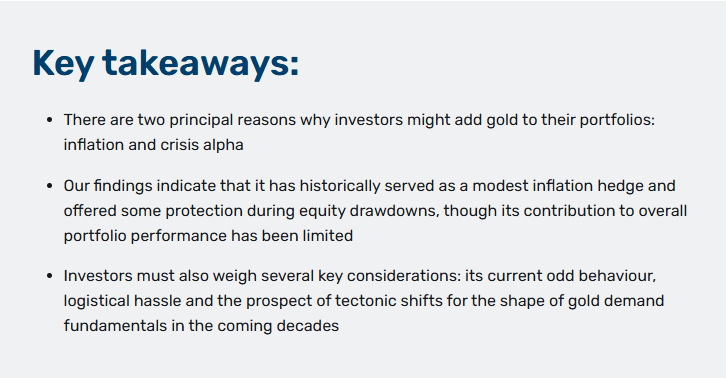
From a portfolio view, there are two principal reasons why you might add gold to your strategic asset allocation. Inflation is the first. A lot of history, as well as more recent times, says that CPI negatively impacts most asset classes. Bonds, the route one hedge, may not provide adequate protection. Could gold be the answer? Over the really long term, we think so. Figure 1 shows gold and inflation since the reign of Henry III of England (1257). Same line. Moreover, Professor Cam Harvey has pointed out that in the time of Nebuchadnezzar (605 BC to 562 BC), an ounce of gold bought 350 loaves of bread. Prior to the recent rally, today’s equivalent was US$7.40. You go to a posh bakery in Hampstead and you won’t get much change from that.
Figure 1: Gold and inflation over the exceedingly long term
Problems loading this infographic? – Please click here
Source: Finaeon, Man Group calculations. Date range: 31 December 1257 – 31 October 2025.
We’d surmise that within 70 years, almost everyone reading these words will be dead. You care about your children, you probably care about your grandchildren, maybe your great-grandchildren at a stretch. But the sort of timeframes just referenced are likely stretching your interest in inter-generational wealth transfer to breaking point. What you likely care more about is how it helps your portfolio on a one-year view, when inflationary fires are burning.
In Figure 2, we show real returns for precious metals (average of silver and gold), cash and a basket of other classic inflation hedges, in 16 inflationary episodes over the past 150 years.1 Bear in mind that before the end of the gold standard in 1971, the precious metals return is essentially silver only, which is not a perfect proxy. But even so, 5/16 won’t exactly have people queuing round the block. The Other Inflation Hedge basket is 9/16. If we limit to just the five post-gold-standard episodes, we get to 3/5. Better, and to be fair, it worked spectacularly in those three. But even with all these ifs and buts, the median inflation episode return is -4.7%. The median real cash return is -3.0%. That of the other hedges is +6.4%. It’s hard to argue above a B-, if we’re marking homework.
Figure 2: Performance in inflationary episodes
Problems loading this infographic? – Please click here
Source: Man Group, Finaeon. Kenneth French online database, Societe Generale, AQR, Bloomberg. Commods is GFD aggregate commodity futures post 1969, backfilled with spot prices for copper, oil and wheat prior to that. TIPS is Bloomberg Barclays TIPS Agg post 1997, prior which we backfill using a GS simulation. All-Asset Trend is Man Group simulated 10 vol trend applied to equity, bond, FX, commodities, going into the Soc Gen CTA Trend Index in 2000. Quality and Momentum are long/short indices constructed by AQR and Fama-French respectively. Date range: July 1879 – June 2022.
The second reason you hold gold is crisis alpha. Manifested in stocks selling off. Many people have lots of equity beta. This is an environment investors find painful, and any portfolio element that relieves that is welcome. As with inflation, there is some validity to the investment 101, but the cake is far from iced. Figure 3 shows the performance of gold and US equities in the 32 10% drawdowns of the latter since the gold standard ended in 1968.
Case for the defence first. Gold’s median return is positive. Its success rate is 59%. In the crying-for-mummy sell-offs (Nifty Fifty, 1970s stagflation, Black Monday, DotCom, Global Financial Crisis, COVID) it, debatably, earns its stripes. Buuuuut… A median return of +1.8% in a median equity drawdown of -15%? You haven’t got out of jail free. Plus, and far be it from us to condescend our reader, but the other side of the coin on a 59% success rate is a 41% negative one. As with inflation episodes, we’d say equity drawdowns give a similar message: yes, it can be a hedge. But it’s no silver bullet (too obvious?).
Figure 3: Gold performance in equity drawdowns
Problems loading this infographic? – Please click here
Source: Bloomberg, Man Group calculations, as at April 2025.
You might say, ‘sure, it’s an average hedge, but it’s still a hedge, I might as well add it to my defensive allocation.’ What impact should you expect? Not much. In Figure 4, we show the same drawdown episodes as those included in Figure 3, but since 1987, due to data availability. The bars represent the performance of two portfolios: a full defensive strategy, with components listed underneath the chart, and the same portfolio without gold. The former has a median return across the episodes shown of 4.4%. The latter is 4.2%. 20 basis points. You’re welcome.
Figure 4: Defensive strategies’ performance in equity drawdown episodes
Problems loading this infographic? – Please click here
Source: Bloomberg, Man Group calculations. Assets defined as follows. Treasuries = Bloomberg Barclays Treasury Agg from 1994, prior to which we simulate returns based on prevailing coupon, yield and duration moves, All-asset trend is Man Group generic trend across equity, bonds, FX and commodities. L/S quality is AQR’s QMJ Index. S&P puts is JP Morgan’s index. Defensive vs. cyclical equities is Goldman Sachs L/S basket based on sensitivity to economic surprises. FCF yield L/S is Man Group constructed based on FCF as a percentage of enterprise value. The strategies are equal vol weighted based on a three-year lookback. Date range: November 1968 – April 2025.
If you like repetition, consider Figure 5, where we combine the two portfolios from Figure 4, at a 20% weight, with an 80% equity allocation. Look really closely, and you might just see two lines. And before you clutch at the straw of, ‘what about the impact in normal times?’, don’t as it’s the same. We won’t show the chart because even those who like repetition are probably now finding this a bit samey.
Figure 5: Equity and defensive allocation combinations
Problems loading this infographic? – Please click here
Source: Bloomberg, Man Group calculations. Defensive portfolio as per Figure 4. Equity is S&P Total Return. Portfolio rebalanced daily. Date range: January 1975 – October 2025.
So, it’s an okay inflation hedge. It’s an okay equity drawdown hedge. It’s certainly not blowing your mind at a portfolio level. And there are costs beyond US$4,000 an ounce. We count three.
First, its current behaviour is odd. Or at least different from a lot of history. Gold trades between 3 and 3.5x its cost of extraction. By far the highest level in 15 years. Its correlation with TIPS is -0.2. The lowest in 25 years. An ounce of gold buys you 66 barrels of oil. With the very brief exception of the COVID weirdness (where you were actually paid to receive crude at some points on the curve), the highest in 55 years. A similar calculation for platinum or silver, per Figure 6, is giving you readings as high as any in 125 and more than 700 years, respectively. From the portfolio constructor’s perspective, there may be something to be said for waiting until it’s all settled down a bit – perhaps the extremity of the recent price action is a harbinger of regime change, and all the behaviours you think you’ve observed are about to change. It’s a bit like foraging for wild mushrooms: if it looks a bit weird, you’re probably better off avoiding it.
Figure 6: How much silver and platinum can I buy with an ounce of gold?
Problems loading this infographic? – Please click here
Source: GFD. Date range: 1257 – October 2025.
Secondly, when you decide you want a gold position, you quickly find yourself in a world of logistical hassle you might have rather avoided. Storage is a genuine consideration for gold in a way in which it is not for financial assets. You can hold US$1000 in S&P stock or US$1 billion in S&P stock, and the difference is some digital ledger entries. For your gold portfolio, the difference would be seven tonnes of sinkable, stealable metal. For this reason, there is a menu of different options in terms of how one might express the trade. In Figure 7, we show six of these, with pros and cons of each. You may know your preference, but the overarching point is, there’s a lot of stuff to think about, even relative to other alternatives. Given the muted impact we’ve discussed, why not save yourself the hassle?
Figure 7: Gold – How to express the trade
Problems loading this infographic? – Please click here
Source: Man Group.
Thirdly, the coming decades could represent tectonic shifts for the shape of gold demand fundamentals. Indian households, for example, currently hold around 25k tonnes of the stuff, representing around 16% of their US$20 trillion wealth, and are buying around 700 tonnes each year. Taking a bull case of 11% nominal growth, and a 2035 asset allocation of 14% gold, would entail annual demand quintupling. On the other hand, a growth bear case of 9%, along with gold allocations falling to 3% (roughly the OECD average) as the economy financialises, would entail net yearly selling of 1,400 tonnes. Neither of these scenarios are realistic, as both assume US$4,000 an ounce stays static. In reality, price would be the clearing mechanism.
Another big lever is what the central banks do. As shown in Figure 8, a little over a quarter of their reserves are in gold. The difference between going to an estimated 60% level which might be reasonable if we reverted, either explicitly or implicitly, to a gold standard, or on the other hand returning to the pre-COVID 10%, is the difference between buying an additional 48k tonnes (relative to just 50k still in the ground) and selling 22k tonnes.
Some roads are going to such different places that it’s hard to remain neutral. I’d suggest this might be one of them. You can’t isolate the portfolio construction maths from the massive structural forces at work in the asset class. And that perhaps means you shouldn’t bother with the former, and just go back to being a trader or a hoarder.
Figure 8: Gold as a percentage of central bank reserves
Problems loading this infographic? – Please click here
Source: Goldman Sachs, IMF, Man Group calculations. Data are annual averages, with the final point being a spot estimate for end October 2025. Projections are made assuming prices remain static at $4k per ounce. Date range: 1950 – 2025.
Gold is often seen as a hedge against regime change, but it too can have its own epoch shifts. Professor Harvey has also written about the deep edge case of extraterrestrial metal. Asterank has detailed more than 500 asteroids with more than US$100 trillion (each) of metals on them, based on current prices.2 It is unclear how much of this total is gold, but if even at a fraction, it would lead to a meaningful glut. And we have some precedent for this in the discovery of the New World through the 16th century, notably Cortes’s conquest of the Aztec Empire (1519-21) and Pizarro’s invasion of the Inca Empire (1532-1533). This brought around 16,000 tonnes of silver, and 150 tonnes of gold online, on a starting stock of 5,000 and 400, respectively. The result, shown in Figure 9, was that between 1477 and 1650, the real gold and silver prices fell 82% and 85%, respectively. This is very unlikely to be viable on any reasonable investment timeframe, but if you were one of the small number of readers taking comfort from Nebuchadnezzar and his loaves of bread… watch out for asteroids.
Figure 9: Gold and silver prices in 2025$ through the 16th century
Problems loading this infographic? – Please click here
Source: Finaeon, Man Group calculations. Date range: 1450 – 1650.
1. Episodes defined simply as those where CPI year-on-year moves through 2%, then through 5%, then peaks. For full definition see: https://www.man.com/insights/best-strategies-for-inflationary-times#:~:….
2. See: https://www.asterank.com/
Important information
All investments are subject to market risk, including the possible loss of principal. It is not possible to invest directly in an index. Alternative investments can involve significant additional risks. Past performance is no guarantee of future results.
Opinions expressed are those of the author and may not be shared by all personnel of Man Group plc (‘Man’). These opinions are subject to change without notice, are for information purposes only and do not constitute an offer or invitation to make an investment in any financial instrument or in any product to which the Company and/or its affiliates provides investment advisory or any other financial services. Any organisations, financial instrument or products described in this material are mentioned for reference purposes only which should not be considered a recommendation for their purchase or sale. Neither the Company nor the authors shall be liable to any person for any action taken on the basis of the information provided. Some statements contained in this material concerning goals, strategies, outlook or other non-historical matters may be forward-looking statements and are based on current indicators and expectations. These forward-looking statements speak only as of the date on which they are made, and the Company undertakes no obligation to update or revise any forward-looking statements. These forward-looking statements are subject to risks and uncertainties that may cause actual results to differ materially from those contained in the statements. The Company and/or its affiliates may or may not have a position in any financial instrument mentioned and may or may not be actively trading in any such securities. Any data services and information available from public sources used in the creation of this material are believed to be reliable. However, accuracy is not warranted or guaranteed. The information provided does not take into account the specific objectives or circumstances of any particular investor, or suggest any specific course of action. Investment decisions should be made based on an investor’s objectives and circumstances and in consultation with his or her financial professionals.
This information herein is being provided by GAMA Investimentos (“Distributor”), as the distributor of the website. The content of this document contains proprietary information about Man Investments AG (“Man”) . Neither part of this document nor the proprietary information of Man here may be (i) copied, photocopied or duplicated in any way by any means or (ii) distributed without Man’s prior written consent. Important disclosures are included throughout this documenand should be used for analysis. This document is not intended to be comprehensive or to contain all the information that the recipient may wish when analyzing Man and / or their respective managed or future managed products This material cannot be used as the basis for any investment decision. The recipient must rely exclusively on the constitutive documents of the any product and its own independent analysis. Although Gama and their affiliates believe that all information contained herein is accurate, neither makes any representations or guarantees as to the conclusion or needs of this information.
This information may contain forecasts statements that involve risks and uncertainties; actual results may differ materially from any expectations, projections or forecasts made or inferred in such forecasts statements. Therefore, recipients are cautioned not to place undue reliance on these forecasts statements. Projections and / or future values of unrealized investments will depend, among other factors, on future operating results, the value of assets and market conditions at the time of disposal, legal and contractual restrictions on transfer that may limit liquidity, any transaction costs and timing and form of sale, which may differ from the assumptions and circumstances on which current perspectives are based, and many of which are difficult to predict. Past performance is not indicative of future results. (if not okay to remove, please just remove reference to Man Fund).